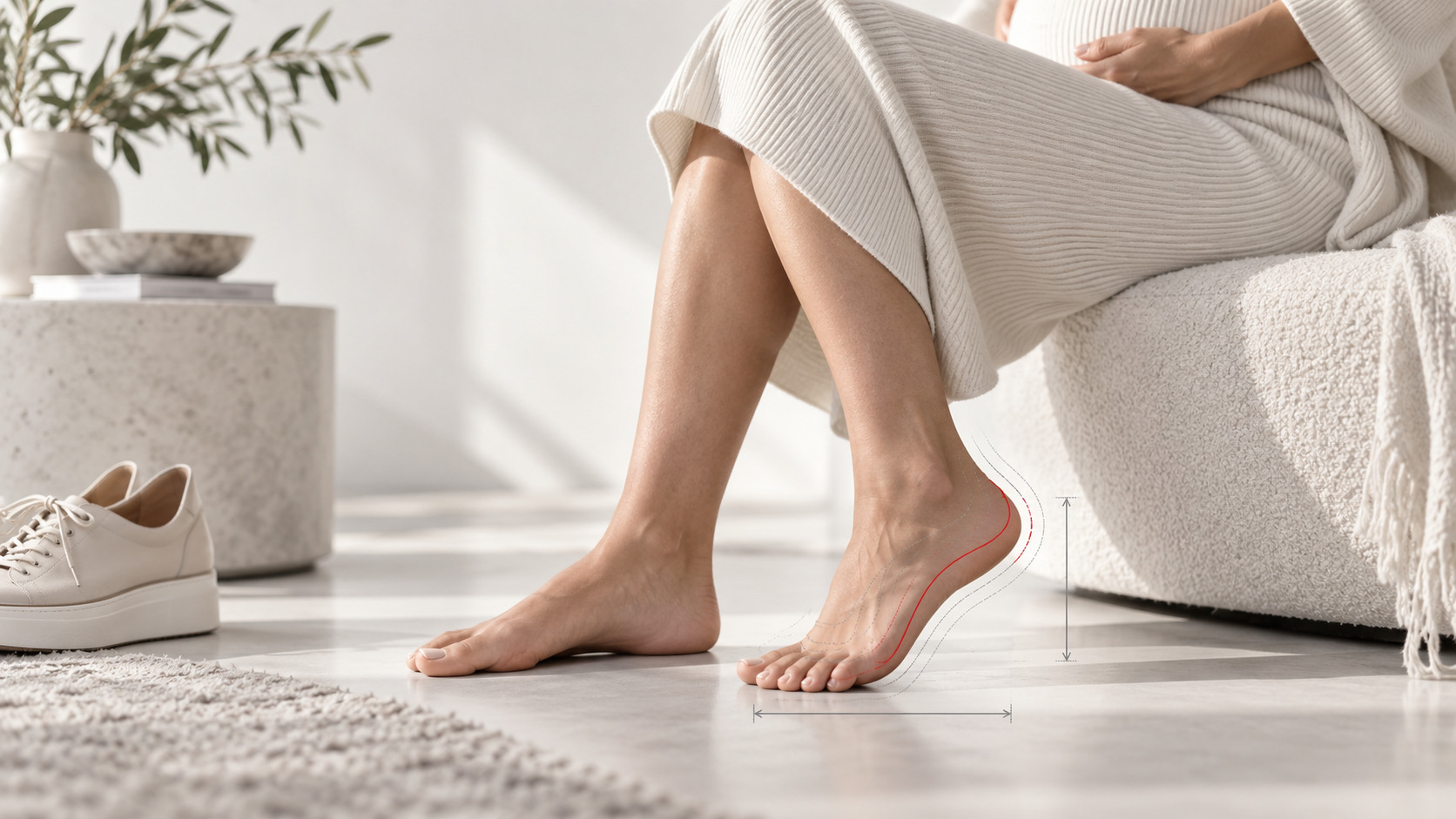
Your feet do not just swell during pregnancy. For a lot of women, they change shape.
Ask around and you will hear the same story: pregnancy makes your feet swell, and once the baby arrives, the swelling goes down and your feet go back to normal. It is a comforting version of events, and for a lot of what happens week to week, it is close enough.
It is also incomplete. A study published in July 2026 by researchers at the University of Pennsylvania followed pregnant women from early pregnancy through the postpartum period, using a digital imaging system to measure foot shape directly rather than relying on self-reported shoe size. They found that foot pain and symptoms affect an estimated 42% of pregnant women, and that some of the foot changes involved extend beyond the pregnancy itself. A separate study out of the University of Iowa, tracking women from their first trimester to five months after delivery, found the same underlying pattern back in 2013: measurable, lasting change to the structure of the foot, not just temporary fluid retention.
The honest version of this story is more specific than "your feet swell." It is also more useful, because it tells you which changes are likely to reverse, which ones might not, and why a shoe that fit perfectly in month two can feel wrong by month seven for reasons that have nothing to do with water weight.
Why this is worth taking seriously
The 2026 Penn study is notable for what it measured beyond simple size. Researchers tracked foot width, dorsum height, foot length, and medial foot area across early, mid, and late pregnancy, then again after birth. Increases in medial foot area and length were associated with clinically meaningful changes in pain interference and physical function, using the Patient-Reported Outcomes Measurement Information System scales that clinicians use to track real functional impact, not just discomfort.
In other words, this is not a cosmetic footnote to pregnancy. Foot shape change was directly linked to how much pain interfered with daily activity and how well women could physically function. A shoe that no longer matches the foot inside it is not just an annoyance during a demanding period of life. It is a measurable contributor to pain and reduced mobility at a time when both already carry real weight.
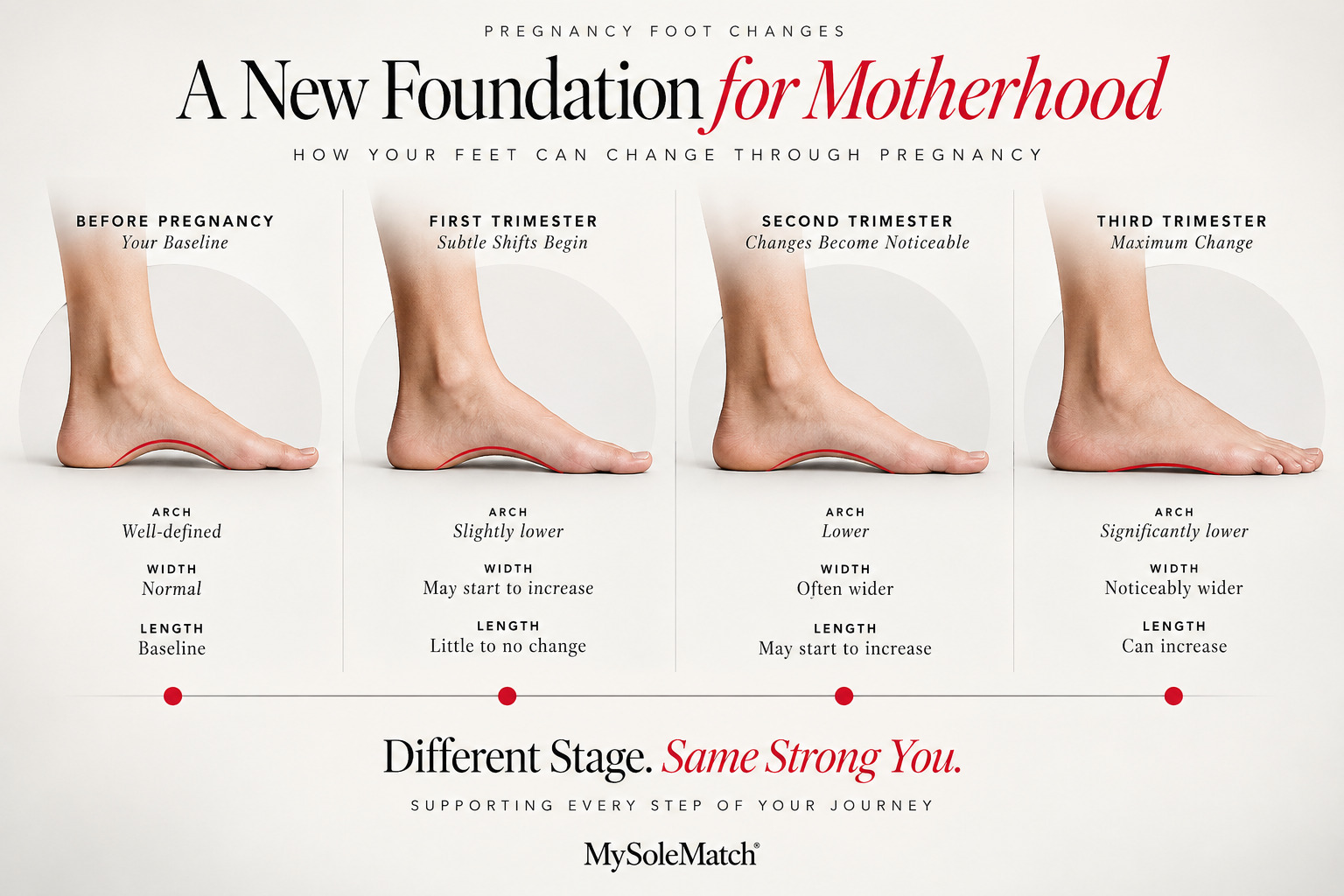
The foot changes shape in stages, not all at once
Length, width, arch height, and swelling do not all move together or on the same timeline. Treating them as one combined event misses what is actually happening.
Length, width, arch, and volume are four different questions
The internet shorthand is "your feet get bigger." That collapses four separate, independently measurable changes into one vague idea, and it is worth pulling them apart.
Length. The 2013 Iowa study measured foot length in 49 pregnant women from the first trimester to five months postpartum. In 60 to 70% of the women, feet became measurably longer, with length increasing between 2 and 10 millimeters. That is real, and for some women it is enough to change a shoe size. It is not, for most people, a guaranteed full size jump, and the change was concentrated almost entirely in first pregnancies. Second and third pregnancies did not reliably add further length.
Width. The 2026 Penn study separately tracked foot width and found it increased across pregnancy independent of length. Width and length do not necessarily change by the same amount or on the same schedule, which is part of why a shoe can start to feel tight across the forefoot well before it feels short.
Arch height and rigidity. The Iowa study found that arch height and a measure of arch rigidity dropped significantly from early pregnancy to five months after birth, with a corresponding increase in arch drop. A 2022 study using force-plate gait analysis found the same direction of change, with arch flattening measured directly during walking and the effect strongest in late pregnancy. This is a structural change to how the foot is built, driven partly by added weight and partly by relaxin, a hormone that increases ligament laxity throughout the body to prepare for childbirth. It loosens the ligaments in the feet along with everything else.
Volume and swelling. This is the one most people already know: fluid retention, most pronounced in the lower legs and feet, most noticeable by the end of the day and in the third trimester. Unlike arch drop or bone length, swelling is genuinely temporary in most cases and typically resolves over the weeks following birth.
Four different mechanisms, four different timelines, and only one of them, swelling, is reliably temporary. The other three involve structural change to the bones, ligaments, and connective tissue of the foot itself.
Does any of this go back to normal?
This is where the evidence gets genuinely more careful than either the popular version or a simple "yes it's permanent" headline would suggest.
The Iowa study is the source of the widely repeated claim that pregnancy permanently changes foot size, and the researchers were direct about their own findings: arch height and rigidity measured five months after birth had not returned to where they started, and the resulting increase in foot length was still present at that point. The lead researcher, Neil Segal, described hearing from women for years that their shoe size had changed with pregnancy and finding nothing about it in the medical literature, which is part of why the study was designed in the first place.
A separate, smaller 2021 study out of Spain measured foot posture and length at three points, early pregnancy, late pregnancy, and four to six weeks postpartum, and found something more modest. Most of the postural measures they tracked did not differ significantly across the three time points. The clearest change they found was a shift toward a more pronated footprint in the third trimester, which had largely returned to a neutral pattern by the postpartum check.
Put those two studies side by side honestly, and the picture is this: the length and arch changes documented by the larger, longer-running Iowa research do appear to persist past childbirth. The more moment-to-moment postural and pronation changes documented by the smaller Spanish study look more likely to settle back down once the pregnancy itself is over. Not every measurable change in a pregnant foot behaves the same way, and treating "pregnancy foot changes" as one uniform, permanent event overstates what the smaller and shorter studies actually found.
Swelling and structural change are not the same problem
This distinction matters more than it might seem, because it changes what a shoe actually needs to do for you at any given point in pregnancy.
Swelling is a volume problem. The foot is temporarily larger because of fluid, and it will most likely release that fluid over the weeks after delivery. A shoe that accommodates swelling well, room in the toe box, adjustable closures, a forgiving upper, does not need to be a permanent size change. It needs to flex with a foot that is fluctuating day to day and worse by evening.
Arch drop and length increase are a structure problem. The bones, ligaments, and connective tissue of the foot have actually changed their resting shape. A shoe that worked for a higher, more rigid arch earlier in pregnancy may genuinely no longer provide the right kind of support for a flatter, less rigid arch later on, and that mismatch will not resolve just because the swelling does.
The Penn researchers made a version of this same point in their 2026 findings: pain and reduced function were most strongly associated with the edema-related changes specifically, not with overall foot morphology in general. That is a more precise finding than "bigger feet hurt more." It suggests the swelling itself, not necessarily the structural remodeling happening underneath it, is doing a meaningful share of the work when it comes to day to day discomfort, even though the structural changes are the ones most likely to still be there months later.
What this means when you are actually buying shoes
Early pregnancy. Structural change is minimal this early. Shoes that fit well before pregnancy will most likely continue to fit well. This is not the phase to buy ahead for a foot that has not changed yet.
Mid pregnancy. Width and early arch changes tend to become noticeable here. A shoe with a wider toe box and some flexibility in the upper accommodates gradual width change without requiring a size change yet. This is a reasonable point to reassess fit rather than assume the shoes from early pregnancy will carry you through.
Late pregnancy. This is when swelling peaks and arch flattening is measurably strongest, according to the 2022 gait analysis research. Prioritize adjustable closures over laces that cannot expand, generous depth through the instep, and genuine arch support rather than a rigid arch shape that was built for a foot structure that has since changed. A shoe that was firm and supportive in month three is not automatically still the right shoe in month eight.
Postpartum. Do not assume your pre-pregnancy shoes will fit again once swelling resolves. Swelling will most likely settle within the weeks after delivery, but the length and arch changes documented by the Iowa research may not fully reverse, particularly after a first pregnancy. It is worth having your foot measured again a few months postpartum rather than assuming a return to your old size.
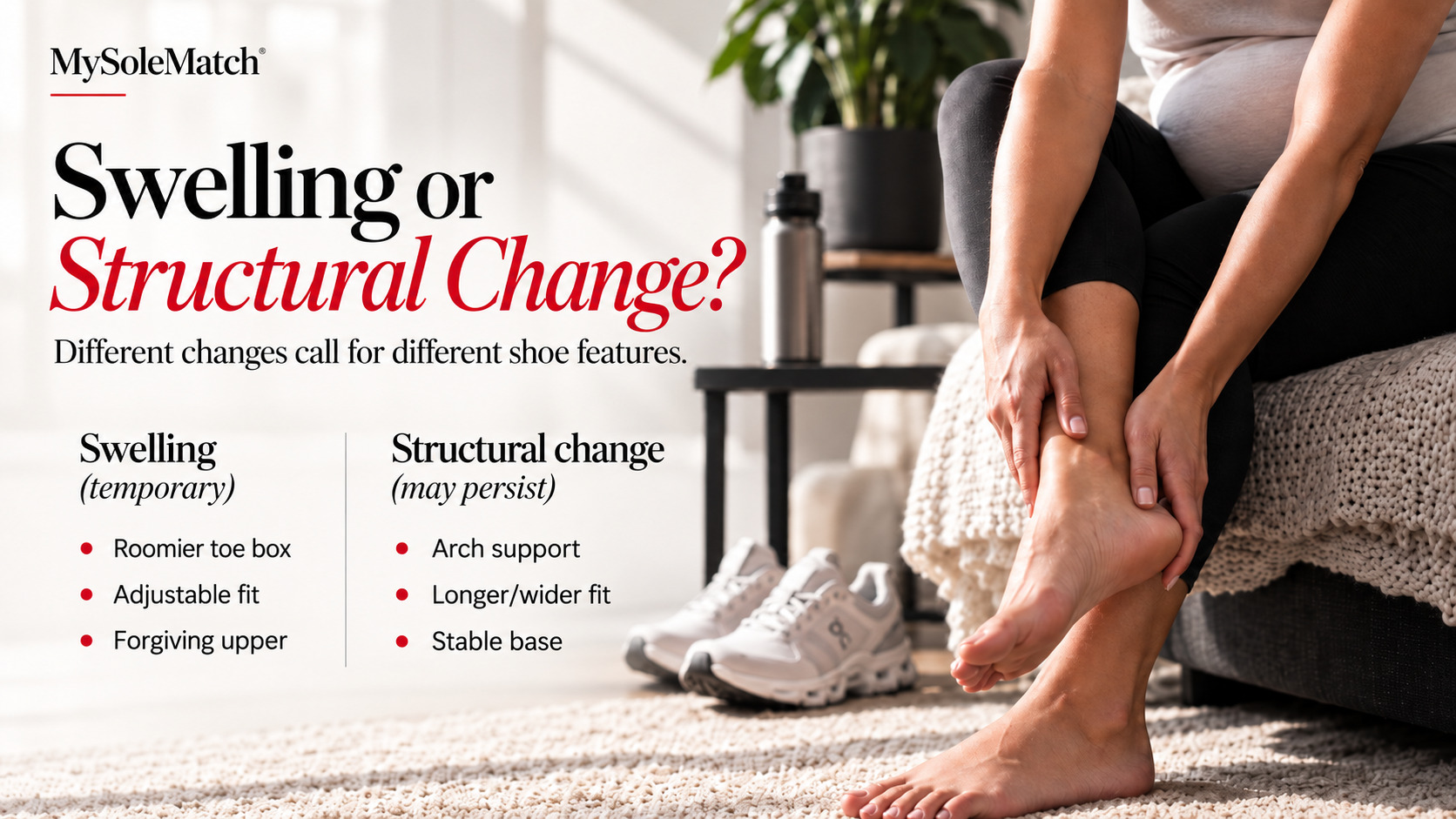
Swelling needs and structural needs call for different shoe features
A shoe that handles daily swelling well is not necessarily the same shoe that supports a genuinely flatter, less rigid arch. Both matter, and they call for different features.
What we can say with confidence, and what we can't
Pregnancy causes measurable changes in foot length, width, and arch structure
2013 University of Iowa study (n=49) and 2026 University of Pennsylvania study (n=31 longitudinal)
EstablishedSome of these changes persist after childbirth rather than resolving with the swelling
2013 study measured changes 5 months postpartum; 2026 study describes symptoms that extend beyond gestation
EstablishedFoot pain and reduced function during pregnancy come mainly from structural change to the arch and bones
2026 study found pain and function were most strongly tied to lower extremity edema specifically, not overall morphology
Supported, but more specific than the popular versionPregnancy permanently increases most women's shoe size by a full size
Measured length increase was 2 to 10 millimeters in 60 to 70% of women, concentrated in first pregnancies. That is a fraction of a shoe size for most people, not a guaranteed full size change
Marketing claimEvery pregnant woman's foot posture and gait change in the same way
2021 longitudinal study found most postural measures were not statistically significant, with the clearest change being a pronation shift in the third trimester
Marketing claimClosing
Pregnancy changes the foot that has to fit inside the shoe. Some of that change is temporary swelling that will most likely resolve. Some of it, particularly arch height and foot length, appears to persist well past delivery, especially after a first pregnancy. Both are real. They are just not the same problem, and they do not call for the same solution.
If your feet have changed during pregnancy and you are not sure whether what you are feeling is ordinary swelling or something worth a closer look, the MySoleMatch pregnancy shoe guide covers footwear by trimester in more depth, and the MySoleMatch shoe finder quiz can match your current symptoms and stage to specific recommendations rather than a generic size assumption. If swelling is sudden, severe, or affecting one side more than the other, that is a signal worth raising with your obstetric provider directly rather than addressing with footwear alone.