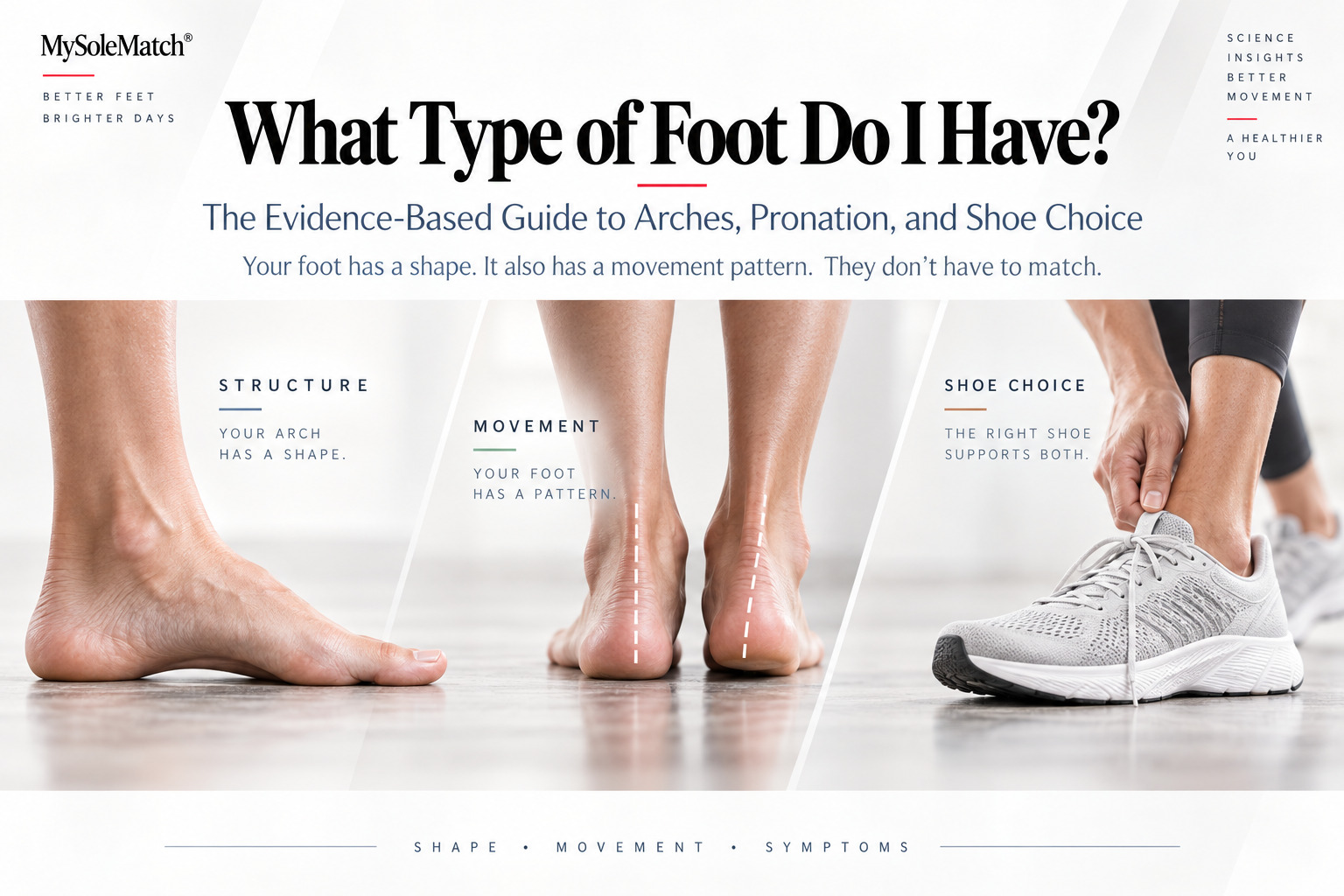
Your foot has a shape. It also has a movement pattern. They don't have to match.
Most people assume these are the same thing. If your arch looks flat, you must overpronate. If your arch looks high, you must underpronate. It sounds logical, and it's the idea behind a lot of shoe recommendations you've probably heard before. It's also not quite right.
A 2026 study looked at 200 feet and measured both separately, how the arch is actually built, and how the foot moves when someone stands. The two didn't line up. Roughly 43% of feet moved in a way that looked like overpronation. But only 19% of those same feet actually had a flatter arch structure. And when researchers checked how often the two showed up together in the same foot, it happened only 16% of the time. Structure and movement, in other words, are mostly telling you two different stories.
That matters because it changes the question you should actually be asking. Not "what's my foot type," as if there's one label that explains everything. Instead: what shape is my foot, how does it move, and does either of those things actually cause me a problem? Those are three different questions, and this guide answers them separately.
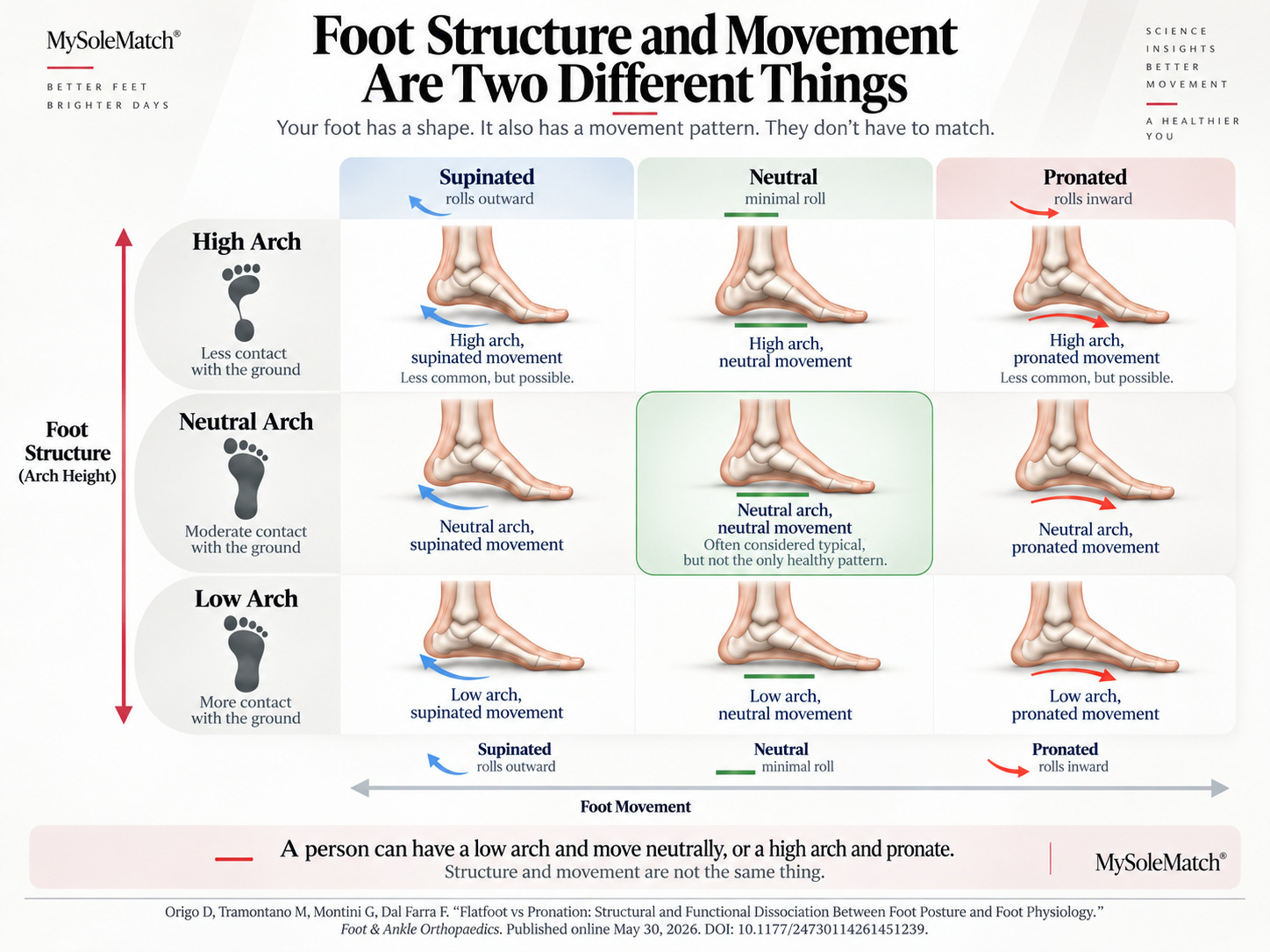
Foot Structure and Movement Are Two Different Things
Arch height (structure) and pronation (movement) are independent variables. A person can have a high arch and pronate, a low arch and not overpronate, or any combination in between.
The three things people mix up
Shape is what your foot looks like when it's just sitting there, not moving. A high arch, a flat arch, something in between. This doesn't change day to day. It's closer to bone structure than behavior.
Movement is what your foot does when you're actually walking or running. Every foot rolls inward a little when it lands, that's normal, healthy, and necessary, it's how your foot absorbs the shock of hitting the ground. That inward roll is called pronation. Rolling outward instead is called supination. Neither one is automatically a problem. The question isn't whether your foot pronates, it's how much, and whether it's causing you trouble.
Symptoms are the part that actually matters for what you do about it. Pain, instability, a shoe that's wearing unevenly and bothering you, those are real signals. A foot shape or movement pattern with no symptoms attached usually isn't something to fix.
Here's the sentence worth remembering: a low arch is not automatically overpronation, a high arch is not automatically supination, and pronation itself is not automatically a problem. Each of those is a separate, independently confirmed fact, not one idea stated three ways.
Why this gets confused so easily
Part of the problem is how foot type actually gets assessed, casually. A wet footprint. A glance in the mirror. Someone watching you walk for ten seconds in a shoe store. Each of those can give you a real clue. None of them is what researchers actually use.
The tool used in real studies checks six separate things on your foot: a small bone near the ankle, the curve of your skin above and below the ankle bone, which way your heel leans, a bulge on the inside of your midfoot, your arch height, and which direction the front of your foot points. Six data points, assessed together, by someone trained to do it. Compare that to a wet footprint, which gives you exactly one piece of that picture, and it's easier to see why a five-second home test and a real clinical assessment can land on different answers for the same foot.
What the popular self-tests actually tell you
If you've ever stepped out of the shower onto a dry towel to check your footprint, or watched the bottom of an old pair of sneakers to see where they wore down, you've already done a version of this. These aren't useless. They're just limited, and knowing exactly where the limit is matters more than the test itself.
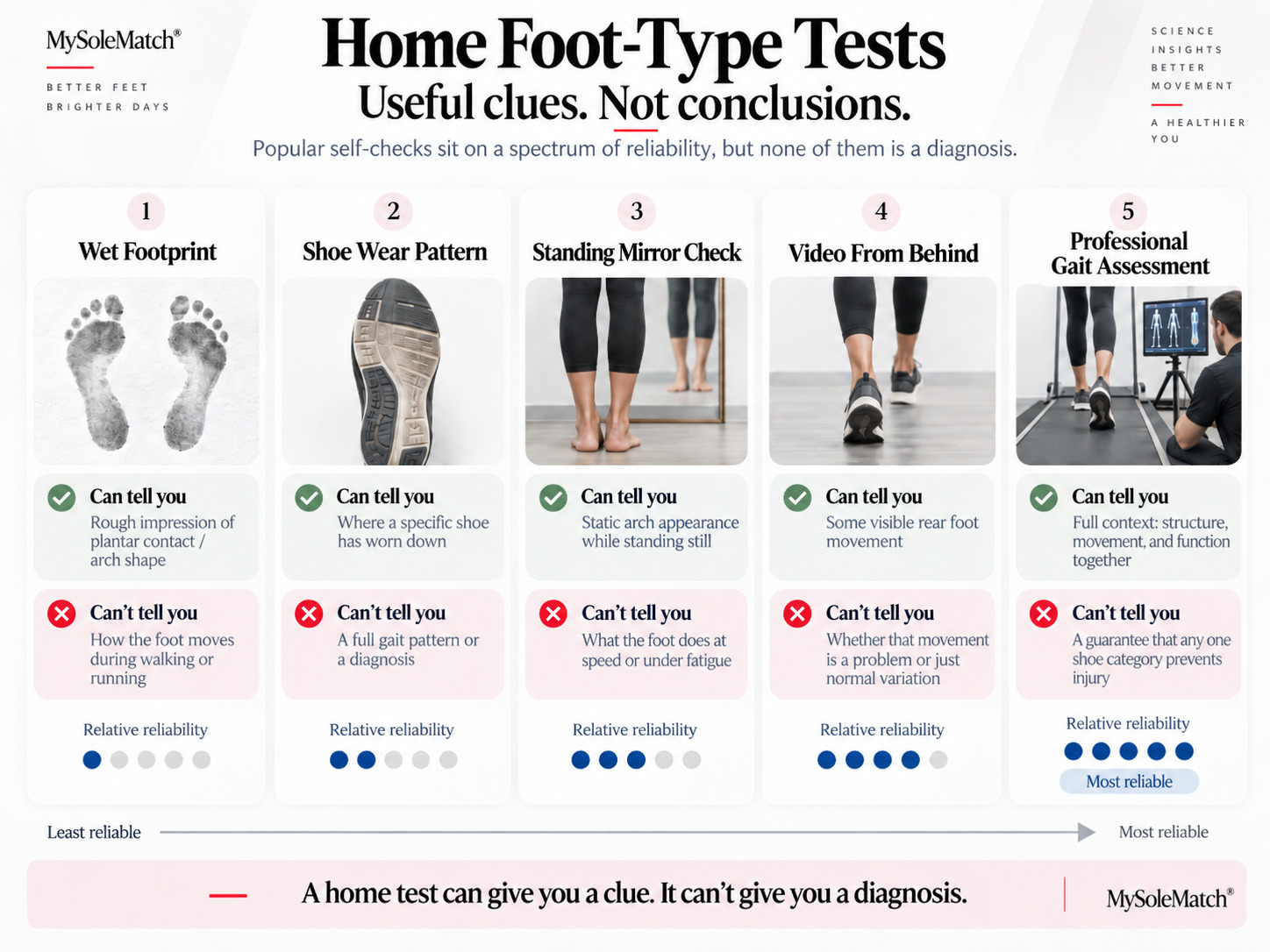
Home Foot-Type Tests: Useful Clues, Not Conclusions
Popular self-checks sit on a spectrum of reliability, but none of them is a diagnosis. Professional gait assessment remains the most reliable option because it evaluates structure, movement, and function together.
A wet footprint shows you a rough impression of how your foot contacts the ground while standing still. It says nothing about what your foot does while you're actually moving. A worn-out shoe sole shows you where that specific shoe took the most pressure, which can be shaped as much by your gait as by the shoe's own design, and it can't tell you whether that wear pattern is a problem or just normal use. A mirror check shows you your arch, at rest, for the two seconds you're standing still to look at it. None of that is nothing. All of it is incomplete.
A home test can give you a clue. It can't give you a diagnosis.
The part the shoe industry doesn't love talking about
Here's where this gets genuinely interesting, and where a lot of shoe advice quietly falls apart: even among researchers who study this for a living, whether "motion control" shoes actually reduce injury is not settled science.
One randomized trial, following 372 recreational runners for six months, found that runners in motion-control shoes had a real, measurable drop in pronation-related injuries like Achilles pain and shin splints compared to runners in standard neutral shoes.
But the U.S. military ran a much bigger version of this same question, three separate times. Researchers matched recruits to motion-control, stability, or cushioned shoes based on their foot shape, then compared them against recruits who all got the same shoe regardless of foot type. They ran this exact experiment in Army Basic Combat Training, Air Force Basic Military Training, and Marine Corps Basic Training. In the Marine Corps trial alone, 722 recruits got shoes matched to their foot type and 689 didn't, and both groups got injured at essentially the same rate. The Army and Air Force versions found the same thing. One of the lead researchers put it plainly afterward: matching shoes to foot type, he said, turned out to be "a sports myth."
So which is right, the six-month running study or the three military trials? Probably both, in different ways, and that's the honest answer, not a cop-out. It suggests shoe-matching by foot type alone isn't a reliable rule for everyone, but it may still help some people, particularly those with real symptoms already, which loops back to the actual point of this guide: the foot-type label by itself was never the thing that mattered. Symptoms and function were.
So what does this actually mean for your shoes?
Here's where all of this comes together into something you can actually use.
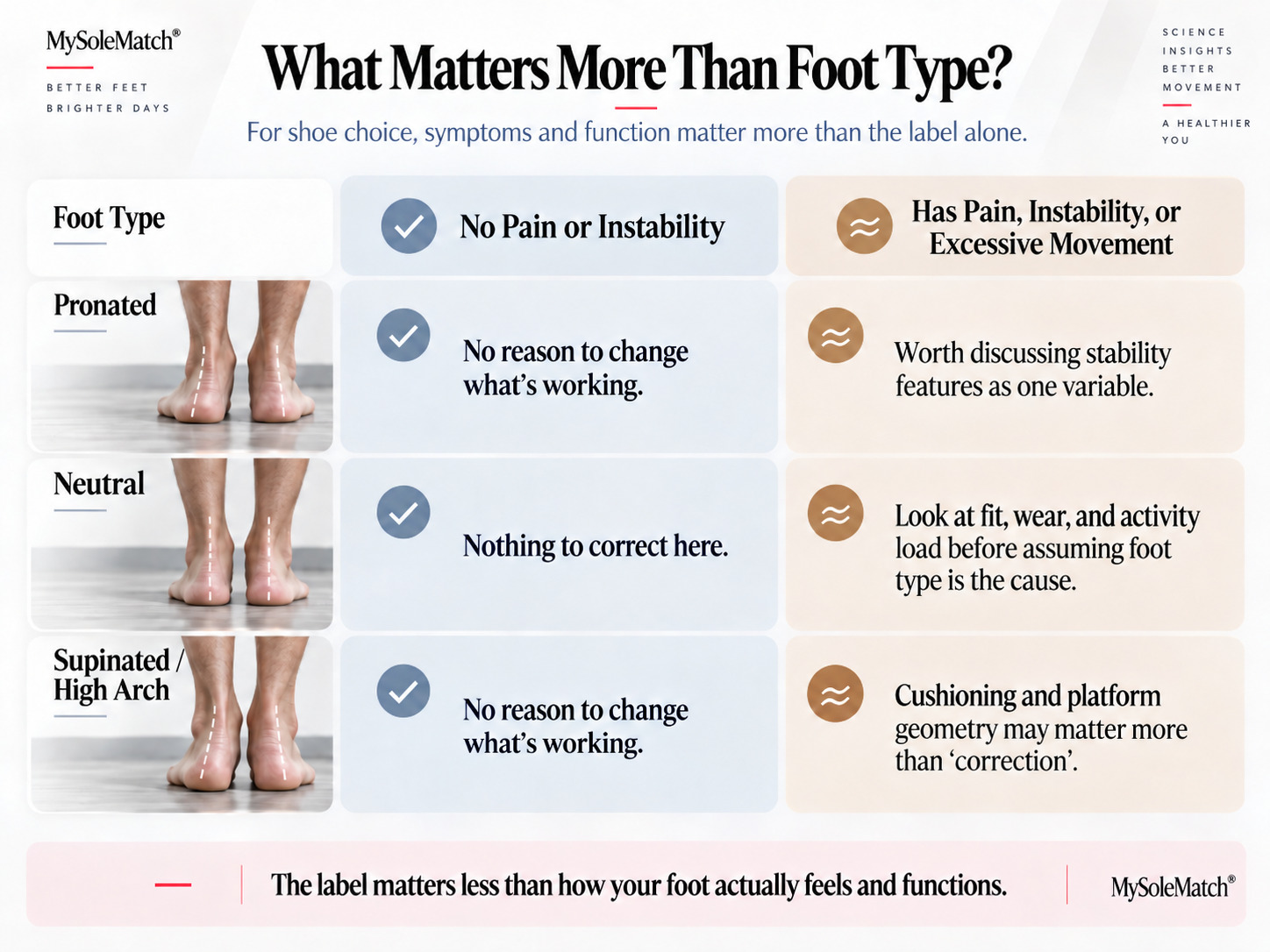
What Matters More Than Foot Type?
For shoe choice, symptoms and function matter more than the label alone. The label matters less than how your foot actually feels and functions.
If your foot pronates, has a low arch, or looks different from what you assumed "normal" meant, and you have no pain, no instability, and nothing bothering you, there's no research-backed reason to change anything. A foot type isn't a problem to fix. It's just how your foot is built and how it moves.
If you do have pain, instability, or a shoe wearing out in a way that concerns you, that's the actual signal worth paying attention to, not the foot-type label by itself. And even then, the honest answer is more nuanced than "buy this shoe category." Fit, comfort, activity level, and how your specific foot responds to a specific shoe all matter more than a static label ever could.
That's the real, practical takeaway: the label matters less than how your foot actually feels and functions.
What we can say with confidence, and what we can't
Structural arch height and dynamic pronation are frequently mismatched, not interchangeable
2026 secondary analysis, 200 feet, no significant statistical association found
EstablishedMotion-control shoes can reduce pronation-related injury in some runners
2021 randomized controlled trial, 372 runners
SupportedMatching shoes to foot type doesn't reliably reduce injury broadly
Three separate randomized military trials, over 4,000 recruits combined
EstablishedOne shoe category is "correct" for a given foot type
Not supported by the research above
Marketing claimClosing
Your foot has a shape. It also has a movement pattern. They don't have to match, and neither one, by itself, tells you what to do next. Pay attention to how your foot actually feels and functions, not the label someone assigns it in five seconds.
Not sure where your own foot actually falls? The MySoleMatch shoe finder factors in your condition, activity, and symptoms together, not a foot-type label alone.