Why an ankle sprain isn't finished when the swelling goes down
You rolled your ankle a few weeks ago. The swelling's gone down. Walking feels mostly normal. But something's still off, stepping off a curb feels less certain than it used to, uneven ground makes you a little nervous, and every so often it just gives way, even when nothing dramatic happened.
If that sounds familiar, here's the first thing worth knowing: an ankle sprain isn't finished the moment the swelling disappears. Recovery is a progression, from injury, to bearing weight again, to restoring motion, strength, and balance, to actually trusting the ankle under real pressure. For most people, that progression finishes on its own. For some, it doesn't, and understanding why is most of what this guide is for.
What's actually happening
An ankle sprain happens when the ligaments that hold the ankle joint together get stretched or torn, almost always from the foot rolling inward, the outside of the ankle taking the force it wasn't built to absorb. It's one of the most common injuries there is, common enough that most people have had one, or know someone who has, without ever thinking of it as a serious injury.
That reputation is part of the problem. Because ankle sprains feel routine, they often get treated casually, walk it off, wrap it, wait it out, which works for plenty of people. But the injury itself sits on a spectrum, from a mild stretch to a full ligament tear, and how it's managed in those first weeks genuinely affects how completely it resolves.
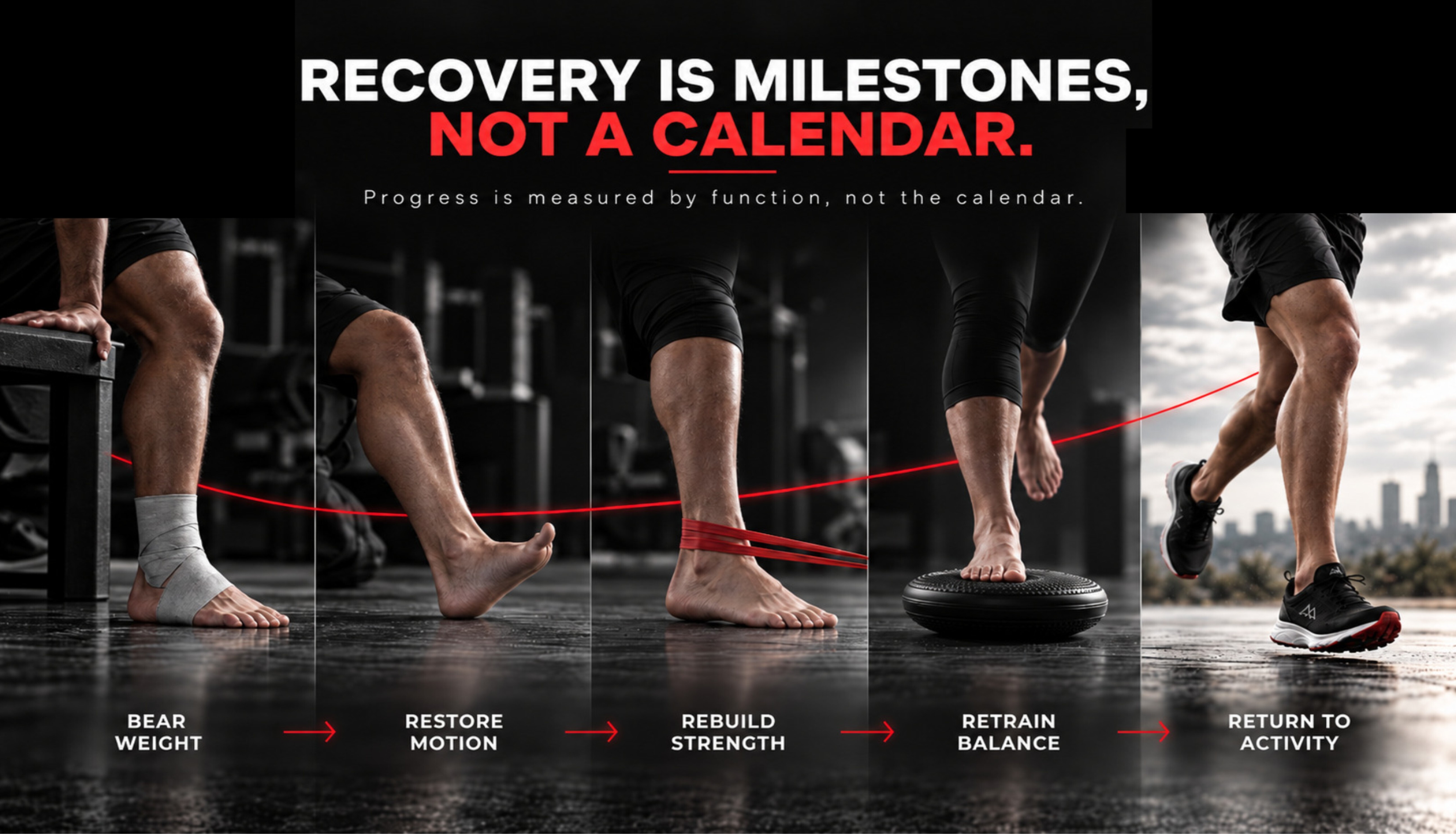
Recovery Is Milestones, Not a Calendar
Real recovery progresses through five functional stages, not a fixed number of weeks.
Recovery is milestones, not a calendar
Search around and you'll find a lot of fixed timelines, rest for this many days, return to sport in this many weeks. The actual clinical guidance moved away from that framing years ago, and for good reason: a sprain in a recreational walker, a competitive athlete, and someone with a prior ankle injury are not the same recovery, even if the ligament damage looks identical on a scan.
The current clinical practice guideline, published by the American Physical Therapy Association's Academy of Orthopaedic Physical Therapy in 2021, frames recovery around restoring function step by step rather than counting days: progressively bearing weight again, regaining full range of motion, rebuilding strength, retraining balance and control, and only then returning to full activity. Each stage has to actually be met, not simply waited through.
That's a more useful way to think about your own recovery too. "It's been three weeks, I should be fine" is a guess. "I can bear full weight without pain, I have my normal range of motion back, and I trust the ankle on uneven ground" is a real progress check.
How clinicians actually decide you're ready: the PAASS framework
If you're wondering how a clinician actually decides someone's ready to return to sport or full activity, there's a real, named answer, not just professional intuition.
In 2021, a group of 24 researchers and clinicians from around the world ran a structured consensus process, three rounds of surveys with 155 health professionals who work in sports medicine, specifically to answer that question. What came out of it is called the PAASS framework, and it organizes return-to-activity readiness into five areas, checked together, not one at a time:
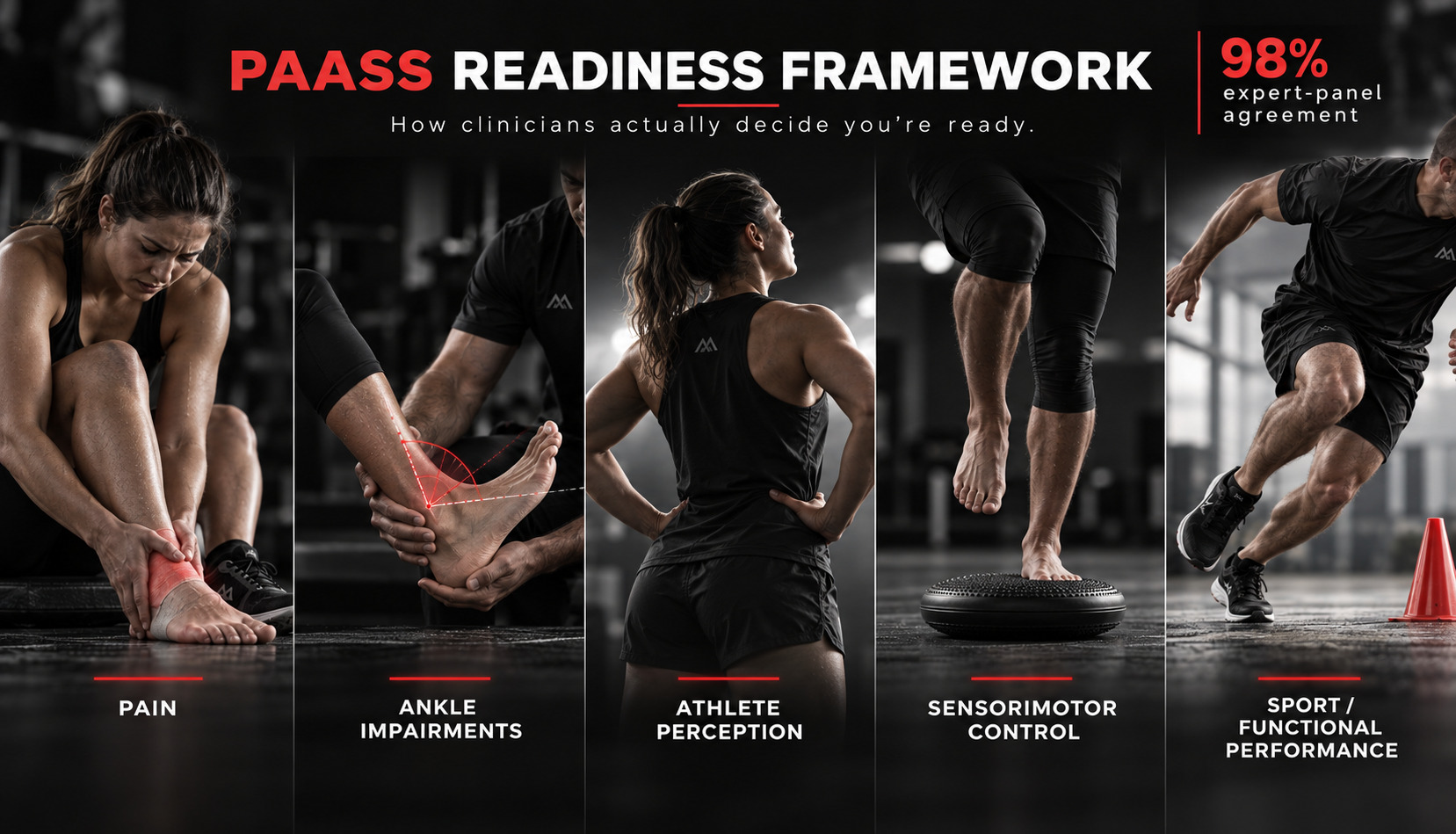
The PAASS Framework
Five domains, backed by 98% expert panel agreement, used to assess readiness for return to activity.
Pain — how much pain during activity, and over the past 24 hours.
Ankle impairments — whether normal range of motion, strength, and endurance have actually come back.
Athlete perception — whether the person actually trusts the ankle, confidence and psychological readiness matter as much as anything measurable.
Sensorimotor control — balance and the ankle's ability to sense its own position, this is often the piece that lags behind everything else feeling fine.
Sport or functional performance — whether hopping, jumping, quick direction changes, and a full session of real activity can actually be done without the ankle giving way.
The panel reached 98% agreement on organizing readiness around these five areas together. Worth being precise about what that number means: it's not a claim that the framework predicts outcomes with 98% accuracy, it's that 98% of the expert panel agreed this is the right way to think about the question in the first place. That's still meaningful, it means there's real, broad clinical consensus behind checking all five areas rather than just asking "does it still hurt?"
When it doesn't fully resolve
For most people, that progression finishes and the ankle goes back to feeling like an ankle again. For some, it doesn't, and the ankle keeps rolling, keeps feeling unsteady, keeps getting reinjured, well after the original sprain should have healed. That's not a failure of willpower or a sign you did something wrong. It's a recognized clinical pattern with a name: chronic ankle instability.
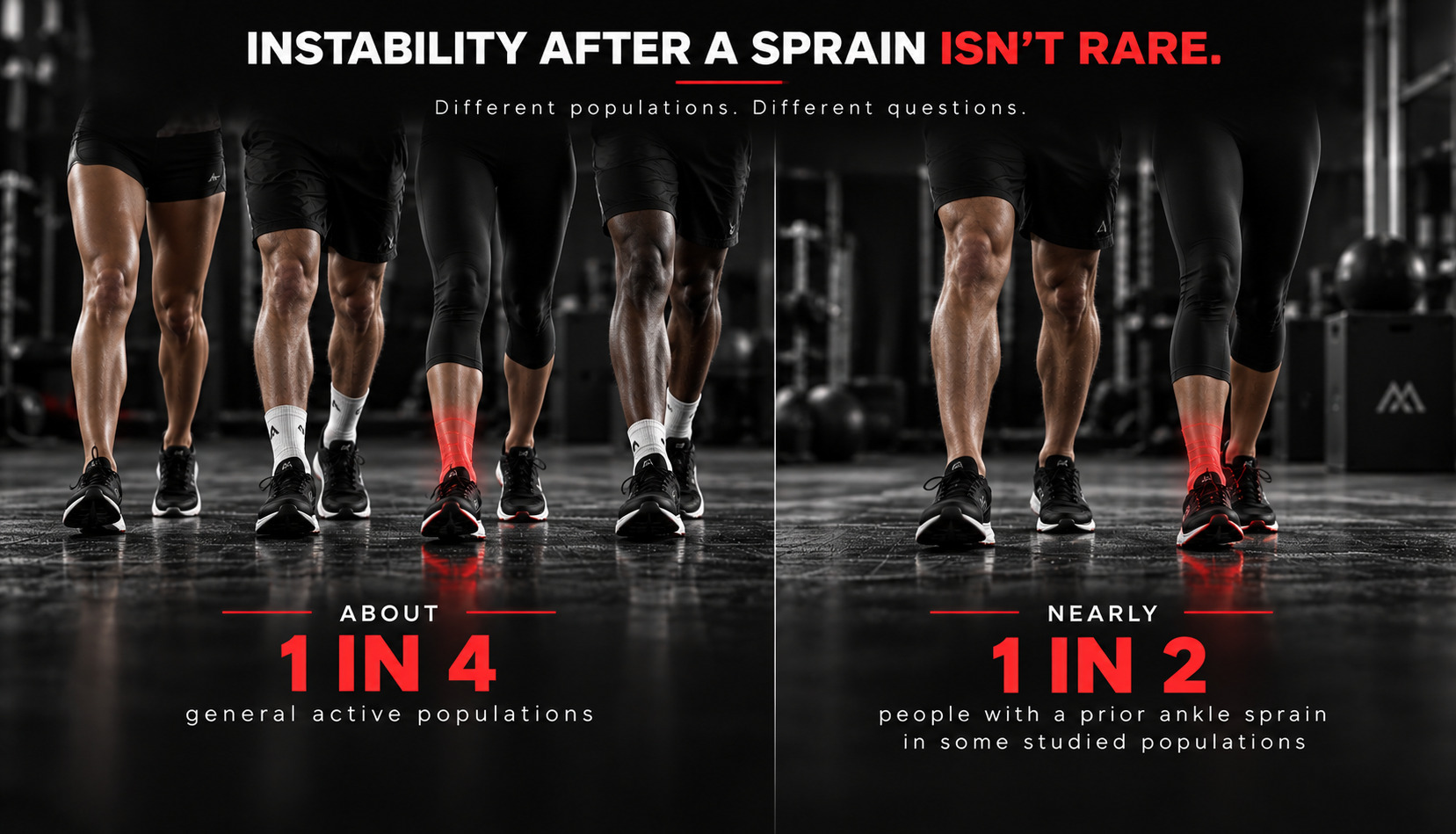
Instability After a Sprain Isn't Rare
About 1 in 4 in general active populations, nearly 1 in 2 among those with a prior sprain, two different questions, not contradictory numbers.
A 2021 systematic review pooling nine studies and nearly 3,800 participants found that chronic ankle instability affects roughly 1 in 4 people in general active populations, and rises to nearly 1 in 2 specifically among people who've already had a prior ankle sprain. Those two numbers aren't contradictory, they're answering two different questions: how common is this generally, versus how common is it once you're already in the group most at risk. Either way, the pattern is the same: instability after a sprain isn't rare, and it isn't something to just quietly live with.
Chronic ankle instability isn't just "a weak ankle." Researchers generally describe it as having up to three components that can show up alone or together: the ankle mechanically being looser than it should be, the sense of the ankle feeling unsteady even when tests don't find obvious mechanical looseness, and simply spraining the same ankle again and again. Someone can have real instability without a single test finding anything visibly wrong, which is part of why this gets dismissed or missed.
Braces, taping, and what actually helps
For a fresh, acute ankle sprain, current clinical guidance supports using external support, a brace or taping, while weight-bearing and activity are being progressively restored. That's a real, guideline-backed recommendation, not a folk remedy.
What the evidence doesn't support is a clean "braces are better than tape" or "tape is better than braces" hierarchy. Both are legitimate forms of external support, and which one makes sense depends on the injury's severity, the stage of healing, and what actually works for the person wearing it. What the research is clear about is that external support is meant to work alongside progressive movement and rehabilitation, not instead of it. A brace that just sits on a resting ankle isn't doing the job it's there for.
The shoe question, answered honestly
Given what this platform exists to do, this is the section worth reading most carefully, because the honest answer here is less exciting than a lot of marketing suggests.
There's a long-standing, intuitive belief that high-top shoes protect against ankle sprains, more material around the ankle should mean more support, the logic goes. The research doesn't back that up cleanly. Some studies do show high-top shoes reduce inward rolling of the foot in controlled, stationary tests. But once someone's actually moving, several studies found no meaningful reduction in sprain risk, and some research suggests high-tops may even increase risk in certain activities. One proposed reason is genuinely interesting: high-top shoes appear to delay and weaken activation of the muscles on the outside of the lower leg, the ones that actively work to stop the foot from rolling, and that delayed activation is already worse in people who have chronic ankle instability. In other words, the shoe some people reach for instinctively may interfere with the exact muscle response that condition already compromises.
There isn't strong modern evidence that any broad shoe category, high-top, low-top, extra cushioning, a particular stability design, reliably prevents a first sprain or speeds up recovery from one. One frequently cited study found basketball players in shoes with air cells in the heel were over four times more likely to sustain an ankle injury than players in shoes without them, a real, striking finding, but it's specific to one shoe technology and one era of research, not a basis for a broad claim about cushioning generally.
The honest, defensible position: footwear is part of the overall picture, activity, surface, prior injury, and rehabilitation all matter too, but no shoe replaces proper assessment, rehabilitation, and, when appropriate, real external support. Choosing a shoe that fits well, feels secure, and works with any brace or support you've been given is a reasonable, useful thing to do. Expecting a shoe alone to prevent or fix ankle instability isn't supported by what the research actually shows.
What we can say with confidence, and what we can't
Recovery from an acute ankle sprain should be guided by functional milestones, not a fixed calendar
2021 clinical practice guideline, Academy of Orthopaedic Physical Therapy
EstablishedThe PAASS framework reflects broad expert consensus on assessing return-to-activity readiness
2021 international Delphi consensus, 155 health professionals, 98% panelist agreement
EstablishedChronic ankle instability affects roughly 1 in 4 people generally, nearly 1 in 2 with a prior sprain
2021 systematic review, 9 studies, ~3,800 participants
EstablishedExternal support (brace or taping) is a supported part of managing an acute sprain, alongside progressive movement
Current clinical practice guideline
SupportedOne form of external support (brace vs. taping) is clearly superior to the other
Not established, both are supported as legitimate options
Marketing claimA specific shoe category (high-top, stability, extra cushioning) reliably prevents a first ankle sprain or speeds recovery
Not supported by modern research; some evidence suggests high-tops may not help once a person is moving
Marketing claimClosing
An ankle sprain has a reputation for being minor, and for a lot of people, it is. But "minor" and "finished the moment it stops hurting" aren't the same thing. Real recovery is a progression, weight-bearing, motion, strength, balance, and finally trust, and skipping ahead in that order is usually where lingering instability starts. If your ankle still doesn't feel fully like your ankle, months after the swelling went down, that's not something to just get used to. It's worth a real conversation with someone who can actually assess it, not just another guess at how many more weeks it'll take.
Not sure whether what you're feeling is normal recovery or something worth getting checked? See When to See a Podiatrist or find a provider near you through Find a Podiatrist.